

The Language of Les Puces
Photography by Benoit Linero / @benoitlinero
The French terms worth knowing before antiquing in Paris
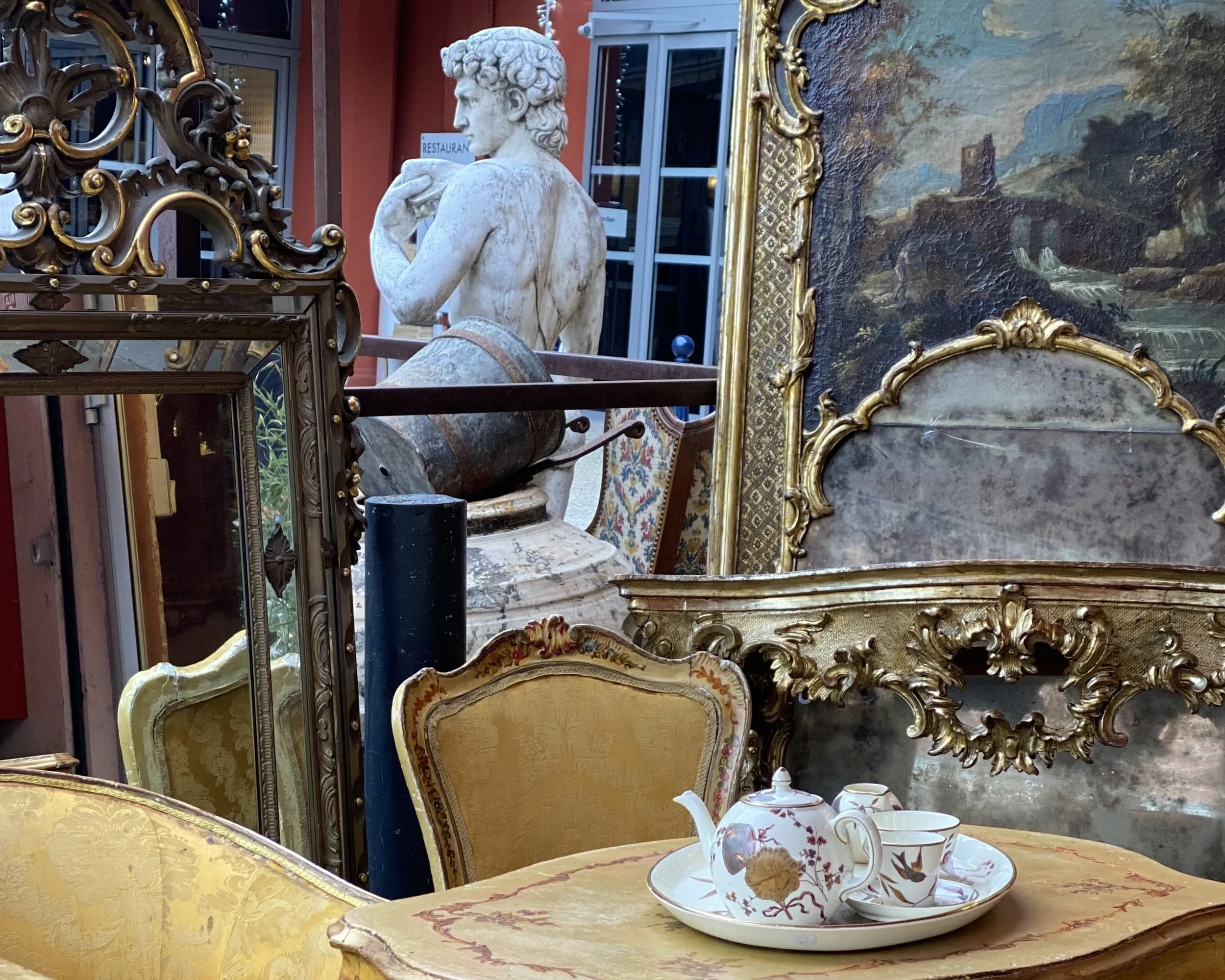
Shopping at Les Puces, the Paris flea market at Saint-Ouen, is one of my favorite things to do. You never quite know what you will find: a beautiful chair hidden behind a table, an extraordinary mirror, or a piece with the perfect patina that suddenly makes an entire room come together.
If you are new to buying antiques in France, there is also a language to it. A few words can tell you whether a piece is original, restored, attributed to a maker, or simply inspired by a particular period.
These are the terms I think are worth knowing.
Dans son jus
One of the expressions you hear constantly in the French antiques world.
It means a piece remains largely in its existing condition rather than having been extensively restored. That may include worn gilding, faded fabric, scratches or signs of age.
And that is not necessarily a bad thing. Very often, those imperfections are exactly what give a piece its character.
Patine
The surface that develops naturally over time through age, light, touch, wax and use.
A beautiful patina is something I often look for. A room becomes much more interesting when everything does not look newly made.
D’époque
If a dealer describes a piece as d’époque Louis XVI, it means it was made during the Louis XVI period itself.
This is very different from de style.
De style
A piece described as de style Louis XVI was made in that style, but not necessarily during that period.
It may still be beautiful and exceptionally well made, but knowing the distinction is important, particularly when discussing value.
Attribué à
Attributed to.
You may see a piece described as attribué à Maison Jansen or another maker. This means there are characteristics suggesting a connection, but not enough evidence to state the attribution with certainty.
It is not the same as signed or stamped.
Signé / estampillé
Signé means signed.
Estampillé means stamped by the maker.
Both can be important when identifying a piece, particularly with antique French furniture and decorative arts.
Restauré
Restored.
This is not automatically something to avoid. Most antiques have lived a life and may have been reupholstered, repaired or refinished at some point.
What matters is understanding what was changed and whether the restoration respects the original piece.
Paire
A pair.
Especially useful when looking at chairs, sconces, lamps, mirrors or small tables.
Always check whether the listed price is for one piece or both.
Suite de
A matching group or set.
For example, une suite de six chaises means a set of six chairs.
Finding a complete suite can be much harder than finding one beautiful chair.
Fauteuil, bergère, chauffeuse
Three chair words worth knowing.
A fauteuil is an armchair.
A bergère is a generous upholstered armchair with closed upholstered sides.
A chauffeuse is a lower upholstered chair, often wonderful in bedrooms and smaller seating arrangements.
Guéridon
A small occasional table, often round.
These are incredibly useful beside a chair or sofa, and I use them constantly.
Commode
A chest of drawers.
French commodes can range from restrained to incredibly decorative, depending on the period and finish.
Enfilade
A long, low storage piece, usually with several doors or drawers.
Particularly useful in dining rooms and salons.
Bout de canapé
Literally, “end of sofa.”
A small side table intended to sit beside a sofa or chair.
For me, part of the beauty of Les Puces is learning to see beyond the obvious. The proportion, the craftsmanship, the patina, the way something has aged — all of these details tell you far more than a label ever could.
Knowing the language helps you understand what you are looking at, but experience is what helps you recognize the pieces with real presence, the ones that can bring character, depth and a sense of history to an interior.
About the Author
Lichelle Silvestry
Lichelle Silvestry is the founder and creative director of Lichelle Silvestry Interiors, an English-speaking interior design studio based in Paris. Known for creating timeless interiors with warmth, elegance, and a deep understanding of her clients’ lives, she blends Parisian refinement with modern comfort for a truly lived-in luxury.
